Your Local Mortgage Broker
Licensed in PA
Proven Results
Buying a home is stressful. Our goal at Side by Side Mortgage is to provide a frictionless experience to all of our clients and referral partners. We do this by measuring twice and cutting once.
Before you find your dream home and make an offer, everything within our control will have already been verified. This not only gives you full confidence that there will be no surprises, but also puts sellers minds at ease - setting you apart from the competition.
Whether you are planning a purchase in Philly or the surrounding suburbs, reach out to see how we can help get you home!
The Home Loan Process
Mortgage Pre-Qualification
Get pre-qualified from one of our Loan Officers to see how much you can afford.
House Shopping
Work with a trusted Real Estate Agent to find a home you would like to move into.
Loan Application
Complete your home loan application to get the lending process started.
Mortgage Programs
Let’s see which loan meets your needs!
Home Loan Options
Our experienced mortgage advisors will walk you through the best mortgage loan program that will fit your specific scenario.
Conventional Home Loans.
FHA Home Loans.
USDA Home Loans.
VA Home Loans.
Right by your side every step of the way!
Most Recent Blog Updates
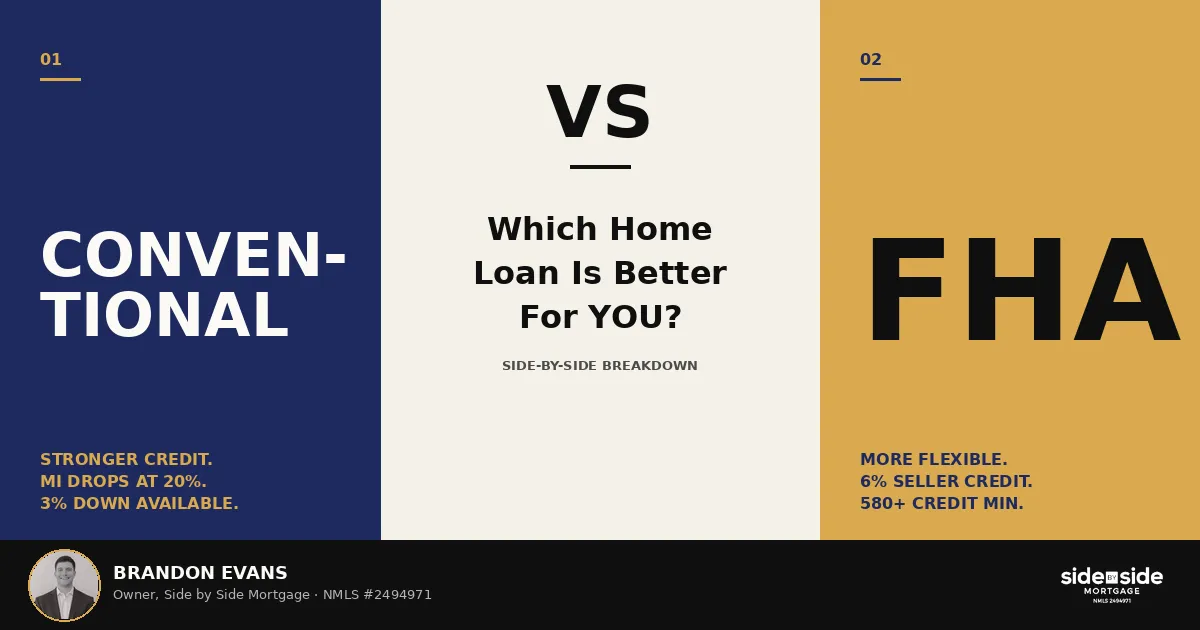
Conventional vs FHA: Which Home Loan Is Better for You?
Conventional vs FHA: Which One Is Better for You?
When people ask whether a conventional loan or an FHA loan is better, the real answer is simple.
The better loan is the one that fits your situation best.
Both loan types have their advantages, and the right choice often depends on your credit score, down payment, debt-to-income ratio, and overall financial goals.
Brandon Evans, owner of Side by Side Mortgage, has seen this firsthand. After launching his Pennsylvania mortgage brokerage three years ago, he has worked with many buyers, especially first-time homebuyers, who are unsure where to begin. One of the most common questions they ask is whether they should choose a conventional loan or an FHA loan.
The answer is not always the same for everyone.
Why This Comparison Matters
Many homebuyers assume FHA loans are only for first-time buyers, but that is not true.
FHA loans can be a strong option for many different types of buyers, not just people purchasing their first home. In many cases, they are especially helpful for borrowers who need more flexibility with credit scores or debt-to-income requirements.
Conventional loans also bring strong advantages, especially for buyers with stronger credit and long-term plans that make lower mortgage insurance costs more appealing.
That is why it is so important to understand the differences.
FHA Loans Are Often More Forgiving
One of the biggest benefits of an FHA loan is flexibility.
In general, FHA loans are:
More forgiving for lower credit scores
More flexible with debt-to-income requirements
Helpful for buyers who may not qualify as easily with conventional financing
A useful option for both first-time and repeat homebuyers
For borrowers who have strong income but less-than-perfect credit, FHA can sometimes open the door to homeownership sooner.
Conventional Loans Can Be Stronger for Well-Qualified Buyers
Conventional loans can be an excellent fit for buyers who have:
Stronger credit scores
Lower debt-to-income ratios
More money available for a down payment
A desire to eventually remove mortgage insurance
For many buyers, conventional financing offers long-term advantages, especially if they are in a position to qualify for strong terms.
Down Payment Differences
One of the first differences buyers look at is the minimum down payment.
Conventional Loan Minimum Down Payment
3% for first-time homebuyers
5% for non-first-time homebuyers
FHA Loan Minimum Down Payment
3.5% for most borrowers
Applies whether you are a first-time buyer or not
If your credit score is below 580, many lenders require 10% down
Some lenders may allow credit scores as low as 500
This means FHA may provide more flexibility in certain credit situations, while conventional may offer a lower minimum down payment for qualified first-time buyers.
Seller Concessions
Seller concessions can be a major advantage for buyers who want to keep more cash in their pocket after closing.
Instead of asking a seller to lower the price, a buyer may ask the seller to cover part of the closing costs. This can be especially useful when a home has been sitting on the market longer than expected.
FHA Seller Concessions
With an FHA loan, the seller can contribute up to:
6% of the sale price
Conventional Seller Concessions
With a conventional loan, the amount depends on the buyer’s down payment:
If the buyer puts down less than 10%, the seller can contribute up to 3%
If the buyer puts down more than 10%, the seller can contribute up to 6%
If the buyer puts down more than 25%, the seller can contribute up to 9%
This is one area where FHA can be especially attractive, particularly for buyers trying to reduce upfront cash needs.
Mortgage Insurance Differences
Mortgage insurance is another major factor when comparing conventional and FHA loans.
It is important to remember that mortgage insurance does not protect the borrower. It protects the lender in case of default when the borrower puts less than 20% down.
Conventional Mortgage Insurance
For conventional loans, mortgage insurance is based on factors like:
Loan size
Debt-to-income ratio
Credit score
The biggest advantage is that once the borrower reaches 20% equity, they can request that the lender remove the mortgage insurance.
FHA Mortgage Insurance
For FHA loans, mortgage insurance works differently.
The cost is more fixed
It is not based the same way on credit score or debt-to-income ratio
If you put down less than 10%, mortgage insurance stays on for the life of the loan
This is one of the most important long-term differences between the two loan types.
FHA vs Conventional: Quick Summary
Here is a simple side-by-side breakdown.
FHA Loan Advantages
More forgiving credit guidelines
More flexible debt-to-income requirements
Seller can contribute up to 6%
Great option for many buyers, not just first-time homebuyers
Conventional Loan Advantages
Lower down payment option for some first-time buyers
Mortgage insurance can be removed after reaching 20% equity
Can be more cost-effective for borrowers with strong credit
Higher seller concessions available with larger down payments
So, Which One Is Better?
The truth is, neither loan is automatically better in every scenario.
The better question is:
Which one is better for you?
That depends on:
Your credit score
Your debt-to-income ratio
How much money you have for a down payment
Whether you want more flexibility now or stronger long-term savings
Your overall homebuying goals
When you work with the right mortgage advisor, the process becomes much clearer. As Brandon Evans puts it, sometimes the right loan picks you, not the other way around.
Final Thoughts
Choosing between conventional and FHA is not about picking the most popular loan. It is about choosing the loan that best fits your financial situation and helps you move forward with confidence.
If you are unsure which path makes the most sense, talking with an experienced mortgage advisor can help you compare your options clearly and make the best decision for your goals.
Need help deciding whether conventional or FHA is the better fit for you?
Reach out to Brandon Evans at Side by Side Mortgage to talk through your options and build a plan that fits your unique situation.

Frequently Asked Questions
How often can I refinance my mortgage?
Technically, there is no limit to how many times you can refinance your loan so long as there is a net tangible benefit. There needs to be a meaningful savings either on a per month basis or in the total interest spent over the loan’s term. But in our opinion, the least amount of times you can refinance your mortgage, the better.
Can I buy a home if I do not have money for a down payment?
Yes - but there is a catch. Now that you are a homeowner, you are 100% responsible for your property. If the HVAC system breaks, if there is a plumbing issue, if the roof needs to be replaced, it’s on you. Down payment assistance is a powerful tool, but it is incredibly important to make sure that you are strong enough financially to be a homeowner, not just cover the down payment.
How do I know which mortgage is right for me?
The key to choosing the right mortgage is to understand the range of options and features available to you, as well as your budget, circumstances, and goals. Our licensed mortgage professionals are here to help you navigate that process. The more you know, the more comfortable and confident you will be choosing the best option for you and your family.
How long will the loan process take?
The Truth in Lending Act (TILA) does not permit a lender to close a loan until at least seven (7) business days have passed from the date your application was received. A typical home loan takes 30 days, as a number of third-party services such as appraisals, title work, and credit are required in conjunction with the mortgage process. Once you familiarize your Loan Officer with the details of your specific loan scenario, they will be able to provide you with a more specific timeline.
Will I qualify for a home loan?
The only way to find out is to speak with a qualified mortgage professional. Our Loan Officers have helped numerous clients who didn’t know if they could qualify to become home owners. We take the time to understand your financial situation and long-term financial goals, and then match you with the loan program that best fits your needs. Your approval for a loan may also largely depend on the price of the home you are financing. Getting pre-qualified prior to beginning your home search can give you an idea of what you may be able to afford.
Why do people refinance their mortgages?
Homeowners typically refinance to save money, either by obtaining a lower interest rate or by reducing the term of their loan. Refinancing is also a way to convert an adjustable loan to a fixed loan or to consolidate debts.
How much money will I have to pay upfront to buy a home?
This question does not have a simple, one-size-fits-all answer. The exact amount will depend on the price of the home you buy as well the type of mortgage financing you choose. Depending on your loan program, your down payment could be as much as 20% of the home’s price or as little as 3%, while some loans require no down payment at all.